
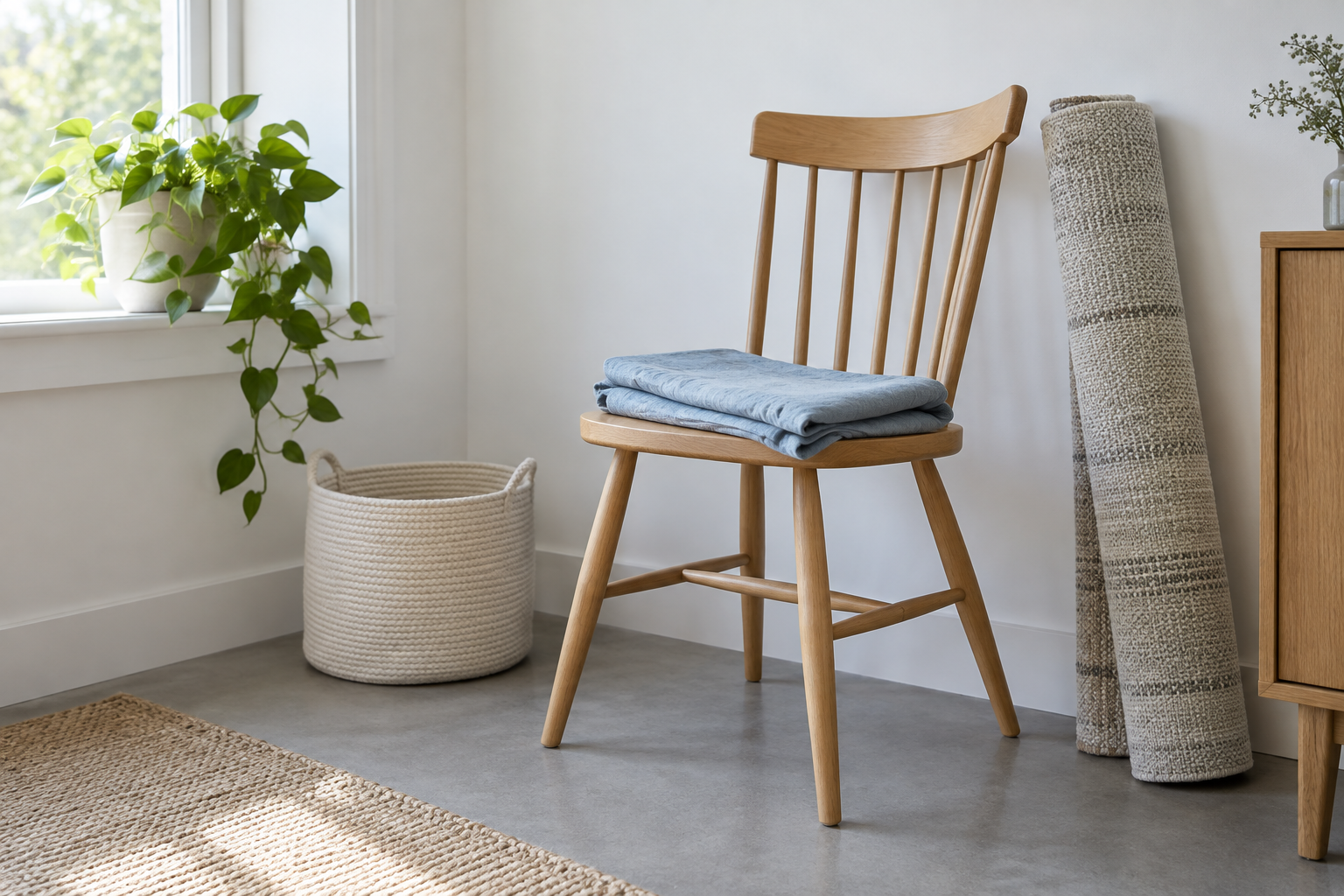
Place chairs where people will actually sit before deciding that a dining table fits. The tabletop's outline is only part of the space required. Pulling out a chair, sitting down and walking behind someone can change the usefulness of an apparently generous room.
Measure the proposed table location and mark the top's dimensions. Use existing chairs or simple markers to represent occupied positions. Open nearby doors and check the route to storage or another room. Rather than relying on one universal clearance number, test the movements your household needs and compare them with the actual furniture dimensions.
Pay attention to what is beneath the top. Legs, a central support or other structural elements can affect where chairs fit and how people sit. Check the distance between legs and the height available under any supporting frame. A tabletop may look wide enough for several chairs while the supports make that arrangement awkward. Ask for a drawing or measurement when photographs leave this unclear.
An extending table has two layouts
Compare the everyday position and the fully extended position separately. Decide where extra chairs will come from and where any removable leaves will be stored. Check the manufacturer's opening procedure and whether moving the table is part of that process. A feature that is manageable a few times a year may be inconvenient if you expect to extend the table every evening.
For a fixed table, consider whether its full capacity serves ordinary use or only an occasional gathering. There is no single correct answer. A household that uses the surface for several daily tasks may value the larger size, while another may benefit more from open circulation. Describe those tasks before treating maximum seating as the main measure of value.
Surface care belongs in the purchase as well. Read the material and finish information and the specified cleaning method. Compare that routine with how the table will be used. Do not assume every wood-looking finish accepts the same treatment or that a decorative photograph demonstrates resistance to ordinary wear.
Imagine a hypothetical table placed between a wall and a cupboard. It fits neatly while chairs are tucked in, but someone cannot open the cupboard when the table is occupied. Recreating the seating arrangement before ordering reveals the problem while you can still choose a narrower top or another layout.
Save the dimensions and assembly instructions with the order. After installation, check the occupied layout again before fixing the positions of nearby furniture. Follow the maker's guidance for extending, moving and maintaining the table. The useful purchase supports both the people seated at it and the everyday movement around it, without requiring the room to remain in its empty showroom arrangement.